Implementing the Lee Filter as a Kornia Transform
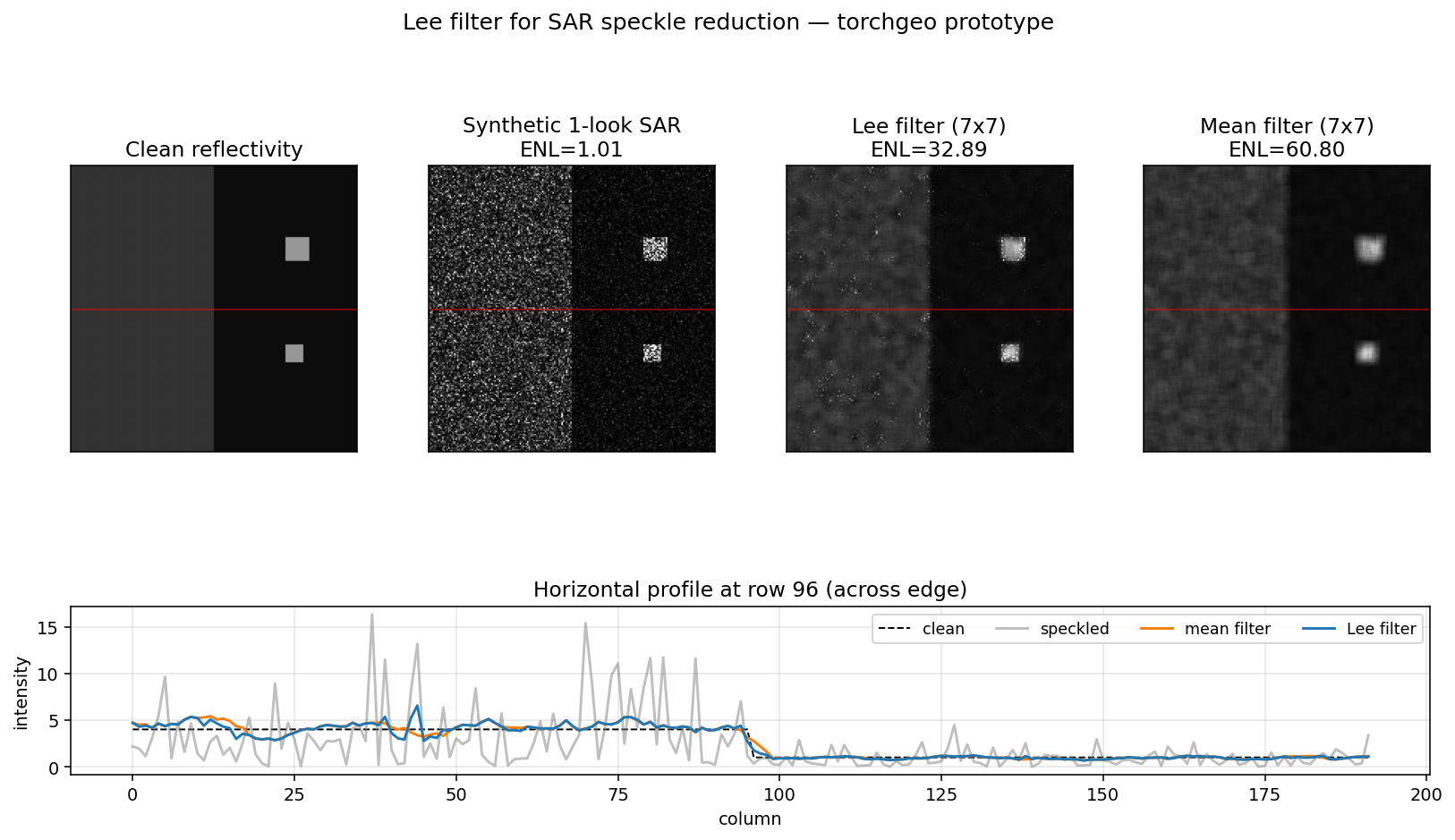
This post is the technical walkthrough behind torchgeo PR #3655, a small contribution that adds the classic Lee (1980) speckle filter to the PyTorch geospatial stack as a Kornia augmentation. I’ll cover three things: (1) why SAR images need a speckle filter at all, (2) the math the filter is doing and how the prototype fell out of it, and (3) the design decisions involved in wrapping it as IntensityAugmentationBase2D so it composes with the rest of the augmentation pipeline.
1. Why SAR images need a speckle filter
If you’ve only worked with optical imagery, the texture of a SAR (synthetic aperture radar) image is jarring the first time you see it. A uniform field, like a flat sea surface, a parking lot, or a recently harvested crop, looks like static. That static is speckle: a multiplicative-noise artefact that follows from how SAR works (coherent imaging summing many sub-resolution scatterers in random phase), not a sensor defect. It’s not going to be calibrated away upstream.
For my Master’s thesis I’m comparing how different speckle-reduction strategies affect deep-learning ship detection in SAR imagery. Detector heads trained on raw single-look intensity see two superficial cues: ships and high-amplitude speckle peaks in calm water. The downstream model then either pays a precision tax (false positives in open ocean) or learns implicit denoising in its early layers, eating capacity it could spend on harder discrimination. Pre-filtering the input is one way to give the detector a cleaner signal, but only if the filter doesn’t smear the ship edges in the process. That edge-vs-smoothing tradeoff is exactly what the Lee filter is designed to handle.
2. The math, and what falls out of it
The Lee filter assumes a multiplicative-noise model:
\[x = s \cdot v\]where \(x\) is what the sensor measures, \(s\) is the underlying scene intensity we want, and \(v\) is unit-mean speckle noise with variance \(\sigma_v^2 = 1/L\) for an \(L\)-look intensity image.
The filter applies a per-pixel linear minimum-mean-squared-error (LMMSE) estimator over a local window:
\[\hat{s} = \mu_x + k \cdot (x - \mu_x), \quad k = \frac{\sigma_s^2}{\sigma_s^2 + \sigma_v^2 \cdot \mu_x^2}\]with \(\mu_x\) and \(\sigma_x^2\) the local mean and variance, and \(\sigma_s^2 = \max(\sigma_x^2 - \sigma_v^2 \mu_x^2, 0)\) the estimated signal variance under the multiplicative model.
Read \(k\) intuitively. In a homogeneous patch, \(\sigma_x^2 \approx \sigma_v^2 \mu_x^2\), so \(\sigma_s^2 \to 0\), \(k \to 0\), and the output approaches the local mean (heavy smoothing). Near an edge, the local variance is dominated by real signal change rather than speckle, \(k \to 1\), and the output approaches the input (pass-through, edge preserved). The filter adapts its smoothing strength to the local signal-to-noise ratio, which is the property worth caring about.
The whole thing is tensor-friendly. Local mean and local mean-of-squares are box filters; everything else is elementwise. That’s the entire prototype:
1
2
3
4
5
6
7
8
9
10
11
12
13
14
15
16
17
18
19
import torch.nn.functional as F

def _box_filter(x, window_size):
    pad = window_size // 2
    x_padded = F.pad(x, (pad, pad, pad, pad), mode='reflect')
    kernel = torch.ones(1, 1, window_size, window_size,
                        device=x.device, dtype=x.dtype) / float(window_size**2)
    C = x.shape[1]
    kernel = kernel.expand(C, 1, window_size, window_size)
    return F.conv2d(x_padded, kernel, groups=C)

def lee_filter(image, window_size=7, num_looks=1.0, eps=1e-8):
    sigma_v_sq = 1.0 / float(num_looks)
    mean_local = _box_filter(image, window_size)
    mean_sq_local = _box_filter(image * image, window_size)
    var_local = (mean_sq_local - mean_local ** 2).clamp(min=0.0)
    var_signal = (var_local - sigma_v_sq * mean_local ** 2).clamp(min=0.0)
    weight = var_signal / (var_signal + sigma_v_sq * mean_local ** 2 + eps)
    return mean_local + weight * (image - mean_local)
Three details worth flagging that aren’t in the textbook statement:
- Reflect padding, not zero padding. Zero padding fakes a step edge into the image at every border, which the LMMSE estimator faithfully preserves, leaving a thick black halo. Reflect padding hides the boundary from the filter.
- Per-channel grouped conv. SAR products often come polarisation-stacked (VV, VH). Treating them as independent channels via
groups=Cis the right default; cross-channel mixing isn’t physically motivated for speckle. clamp(min=0)onvar_signal. Under finite samples in a noisy patch, \(\sigma_x^2\) can dip below \(\sigma_v^2 \mu_x^2\) and produce a negative variance estimate. The clamp keeps the estimator well-defined; without it you get NaNs in the gradient on the first batch.
Below is the demo figure I generated for the proposal: synthetic SAR-like input on the left, Lee-filtered output on the right. The point isn’t “look how clean”; it’s that the bright-on-dark step edges in the middle survive while the homogeneous patches calm down.
Synthetic 1-look intensity image with multiplicative speckle, before and after Lee filtering (window size 7).
3. Wrapping it as a Kornia IntensityAugmentationBase2D
The functional version above is fine for a script. To actually live inside the torchgeo / Kornia ecosystem, where a transform composes with random crops, geometric augmentations, normalisation, and the usual p=0.5-style probabilistic application, it needs to subclass kornia.augmentation.IntensityAugmentationBase2D. Kornia splits augmentations into intensity-only (don’t change geometry) and geometric (do); the Lee filter is unambiguously the former, which means it inherits the right batched/probabilistic plumbing for free.
1
2
3
4
5
6
7
8
9
10
11
12
13
14
15
16
17
18
from kornia.augmentation import IntensityAugmentationBase2D

class LeeFilter(IntensityAugmentationBase2D):
    def __init__(self, window_size=7, num_looks=1.0,
                 p=1.0, same_on_batch=False, keepdim=False):
        super().__init__(p=p, same_on_batch=same_on_batch, keepdim=keepdim)
        if window_size < 1 or window_size % 2 == 0:
            raise ValueError(f'window_size must be a positive odd integer, got {window_size}')
        if num_looks <= 0:
            raise ValueError(f'num_looks must be > 0, got {num_looks}')
        self.flags = {'window_size': window_size, 'num_looks': num_looks}

    def apply_transform(self, input, params, flags, transform=None):
        return lee_filter(
            input,
            window_size=int(flags['window_size']),
            num_looks=float(flags['num_looks']),
        )
A few choices worth justifying:
flags, not__init__attributes, hold the parameters. Kornia’s base class re-passesflagsintoapply_transform, which is the contract you want to honour so the transform plays nicely withsame_on_batch,keepdim, and serialisation. Storingself.window_sizeinstead works in the simple case but breaks when you stack the filter inside ann.Sequentialof augmentations and Kornia walks the tree.- Validation in
__init__, not inapply_transform. Speckle filters get applied many times per epoch; doing the odd-integer check on every call wastes compute. Fail loud at construction. - Default
p=1.0. Unlike a flip or a colour jitter, a despeckling filter isn’t a random augmentation. It’s a preprocessing step you almost always want applied.pis exposed so users can randomise it (e.g. mixing filtered and raw samples to make the detector robust to either), but the default reflects how the filter is actually used in practice.
The PR (#3655, +316 / −0, currently in review with five maintainers) ships this LeeFilter class plus the functional lee_filter API, exposed through torchgeo.transforms.LeeFilter, with 28 tests covering the new module at 100% line coverage: parameter-validation paths, batched application, single- and multi-channel inputs, gradient flow, device placement, and the same_on_batch / keepdim Kornia contracts. There’s a fix commit on top of the original push that wraps the test-module’s import scipy in pytest.importorskip(...) to keep torchgeo’s optional CI job (Python 3.14, no [datasets] extras) happy. Small but project-specific, worth respecting if you’re sending your first torchgeo PR.
What’s next
The natural follow-up (and the one a maintainer has already flagged as the logical PR #2) is RefinedLeeFilter, Lee’s own 1981 follow-up that replaces the box-window local statistics with edge-aware directional sub-windows. Better edge sharpness at the cost of a more complicated kernel. That’s the next post in this series.
If you spot something off in the implementation above, or want to discuss SAR despeckling for object-detection pipelines, the PR thread is the best place. You can also open an issue against my fork and I’ll get back.